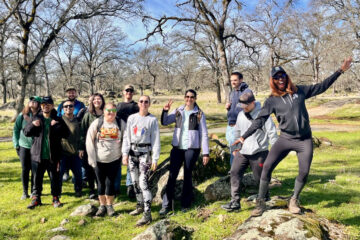
Did you know that there are currently several scientific research projects taking place on Placer Land Trust preserves? This is the first in a series of articles about the important research taking place on our protected lands.
By Jacqueline Holmes
Ph.D. Student, Department of Ecology & Evolutionary Biology, University of California, Los Angeles
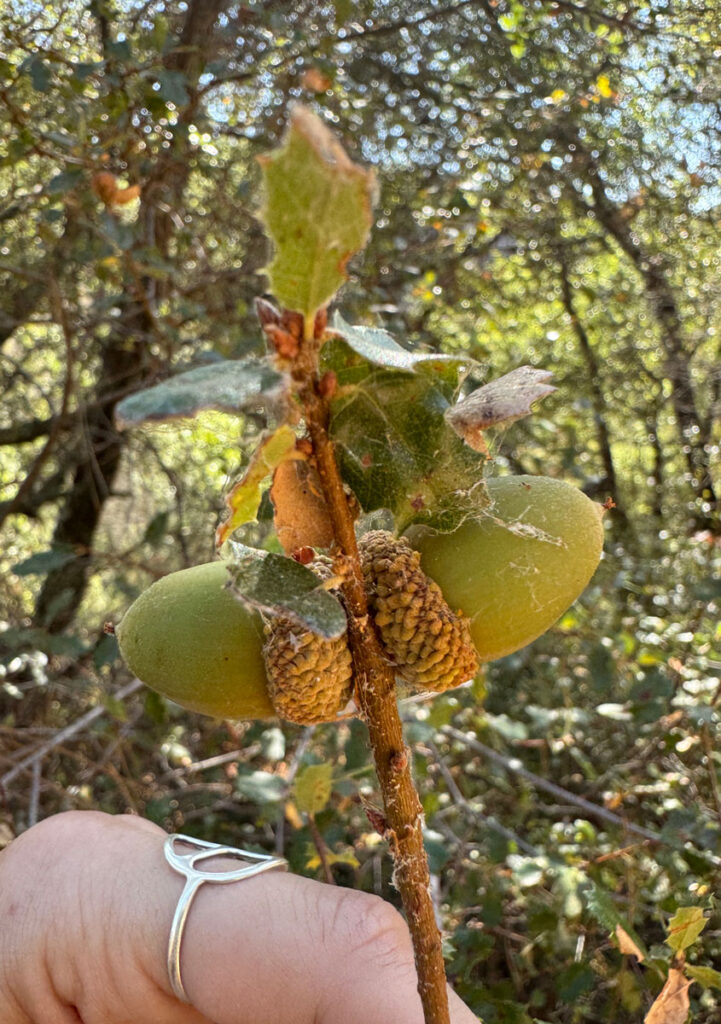
I am a Ph.D. student in UCLA’s Department of Ecology and Evolutionary Biology, studying California scrub oak (Quercus berberidifolia) at sites including Placer Land Trust’s Shutamul Bear River Preserve. My work is part of a statewide effort to understand how this species may adapt to future climate warming.
I identified scrub oak locations using herbarium records, species distribution maps, and iNaturalist observations, and that’s how I found PLT’s Shutamul Preserve. At each site, I sampled two to four individual shrubs, collecting leaves for DNA extraction and voucher specimens (small branches or stems with leaves attached) for species identification and documentation. Leaf samples were kept on ice and returned to UCLA within three to five days, where they were stored at –80°C. DNA is extracted in the Sork Lab at UCLA and sent to UC Davis for whole-genome sequencing.
My research focuses on how native plants are responding to changing environmental conditions, such as rising temperatures and longer, more frequent periods of drought. Long-lived plants like shrub oaks are especially vulnerable because they cannot move quickly, they reproduce slowly, and they disperse seeds over short distances. Although chaparral ecosystems are adapted to dry conditions, they are experiencing increasing plant loss.
California scrub oak is widespread across the state and plays a key role in chaparral by supporting wildlife, storing carbon, and maintaining soil health. If scrub oak declines, large areas of chaparral could be lost. By using genomic data, I aim to identify populations that are most likely to tolerate future climate conditions and could serve as seed sources for restoration, helping protect chaparral ecosystems in the decades ahead.
Read more about Jacqueline’s project here (PDF).