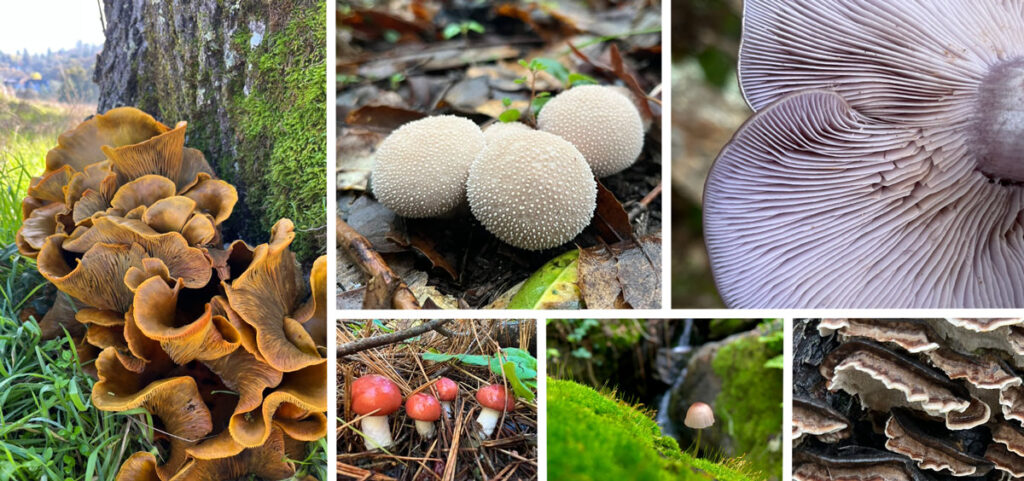
Clockwise from left: Jack-o’lantern mushrooms (Omphalotus) are so named because they glow in the dark; a tiny puffball; the wood blewit (Collybia nuda) is one of several lilac-hued mushrooms in our area; turkey tails (Trametes versicolor) grow like ruffled fans on wood; look closely at mossy boulders and trees to see who else is lurking; brightly-colored Russula mushrooms are especially common this year.
December 10, 2025
By Julia Boorinakis Harper Barbeau
It has been an incredible year for mushrooms in the foothills, as you may have noticed! We’re seeing a tremendous fungal diversity in our area, and the oak woodland trails at Canyon View Preserve are a prime spot to observe a wide variety of mushrooms and other fungi.
While there are abundant edible mushroom species in our region, you certainly do not have to eat mushrooms to enjoy looking for them! In fact, unless you are an experienced mushroom forager, it’s not a good idea to eat anything you find without expert identification. Think of it as looking for wildflowers, but for the fall and winter — if you are intrigued by our natural world, finding and identifying a new-to-you species can be a rewarding thrill in itself!
Identification apps and AI tools are becoming popular, but they are notoriously unreliable for fungi, and many myologists still recommend using a mushroom field guide book with a key to assist in identification. Mushrooms have a variety of important characteristics that simply cannot be detected from a photograph — even more so than plants.
When photographing mushrooms for identification, be sure to take pictures of the gills or pores (underside of the cap), stipe (the stalk), and surroundings, as well as just the cap of the mushroom. An app can help you narrow down possibilities, but aspects like gill and spore color, smell, and texture can be vital for distinguishing between similar-looking species.
If you would like to try identifying the mushrooms you find, here are some details to note:
- What does it smell like? How would you describe the fragrance – fruity, chemical, earthy, spicy, fishy?
- What is the texture of the flesh when broken? Does the mushroom snap cleanly like chalk, or is it tough, stringy, or spongy? Does it ooze any kind of milk or liquid after being broken?
- What is the texture of the cap — slimy, sticky, dry, papery, velvety, shiny, matte? Does it have any scales, patches, or flakes on it?
- Check the underside of the cap — does it have blade-like gills, spongy pores, or something else? What color are they? Can you see any spore “dust” that has settled on the stalk or ground nearby?
- If there is one more than one mushroom that appears to be of the same species, what variations do you see between them? Size, shape, color, different stages of maturity?
- What trees, shrubs, or plants are growing nearby? If you are photographing or sketching a mushroom for identification later, it can be helpful to include some nearby leaves and plant material, since certain fungi are symbiotic with particular tree or shrub species.
- What is the soil like? Is the mushroom growing out of leafy loam, dirt, a compacted road or trail, or a piece of wood? If it appears to be growing from the soil, can you find any tree roots or decaying wood under the ground?
Toxic mushrooms are generally safe to handle and smell; just be sure to wash your hands afterward. Many guidebooks include a dedicated section on how to identify common toxic mushrooms, you may want to review this and avoid touching those species, especially if you have children on your outing.
And remember, even if a mushroom looks like a familiar edible species, or you looked it up and feel pretty sure you know what it is, you should never eat it without accurate identification from an experienced person! Going on an organized “class”-style outing or mushroom hunt with a trained mycologist is a great way to get started, and to learn what to look for as well as what to avoid. There are a number of toxic and even deadly species growing in our area — including at Canyon View Preserve – so safety is vital if you wish to venture into foraging for edible mushrooms!
One last interesting note: Unlike wildflowers, you can actually “pick” individual mushrooms without causing harm. The mushrooms that we see are the fruiting bodies of a larger fungal organism — think of it as picking a strawberry, versus digging up the whole plant. Of course, it’s still best to be respectful and pick only one or two specimens for identification, leaving the rest for wildlife and other hikers to enjoy! Mycologists and mushroom hunters discourage “vacuuming the forest” and collecting all the mushrooms in sight, even for valuable edible species.
Happy hunting!
If you want to dive further into the world of mushrooms, here are a few places to start:
Sacramento Area Mushroomers is a Sacramento-based club for “all things fungal.” (Side note: mushroom clubs, societies, and events tend to be populated by friendly, enthusiastic folks who are super-welcoming to newbies and anyone mushroom-curious, so don’t feel like you have to be an expert to get involved!)
Fork in the Path offers foraging classes, including some in our area.
ForageSF also holds foraging classes in Northern California.
An interesting article from the Cascade Mycological Societyabout the wide, wonderful world of mushroom smells: What is that odor?
If you are looking for a mushroom field guide, David Arora’s All That The Rain Promises and More is a great place to start — it’s compact, covers many of the most common and interesting mushrooms in our area, and is a good introduction to using a dichotomous key to identify species.
Arora’s larger volume, Mushrooms Demystified, is a classic — you will see well-worn, much-loved copies being toted about at almost any mushroom-related gathering! With 2000+ species, you may not want to carry it on longer hikes, but it’s well worth having on your shelf if you are fascinated by the world of fungi.
Another favorite on my shelf, Mushrooms of the Redwood Coast by Noah Siegel and Christian Schwartz, is a more recent publication that covers many Northern-California-specific species. It isn’t built around a dichotomous key, like Arora’s books, but is still easy to navigate thanks to excellent photographs and detailed text descriptions.